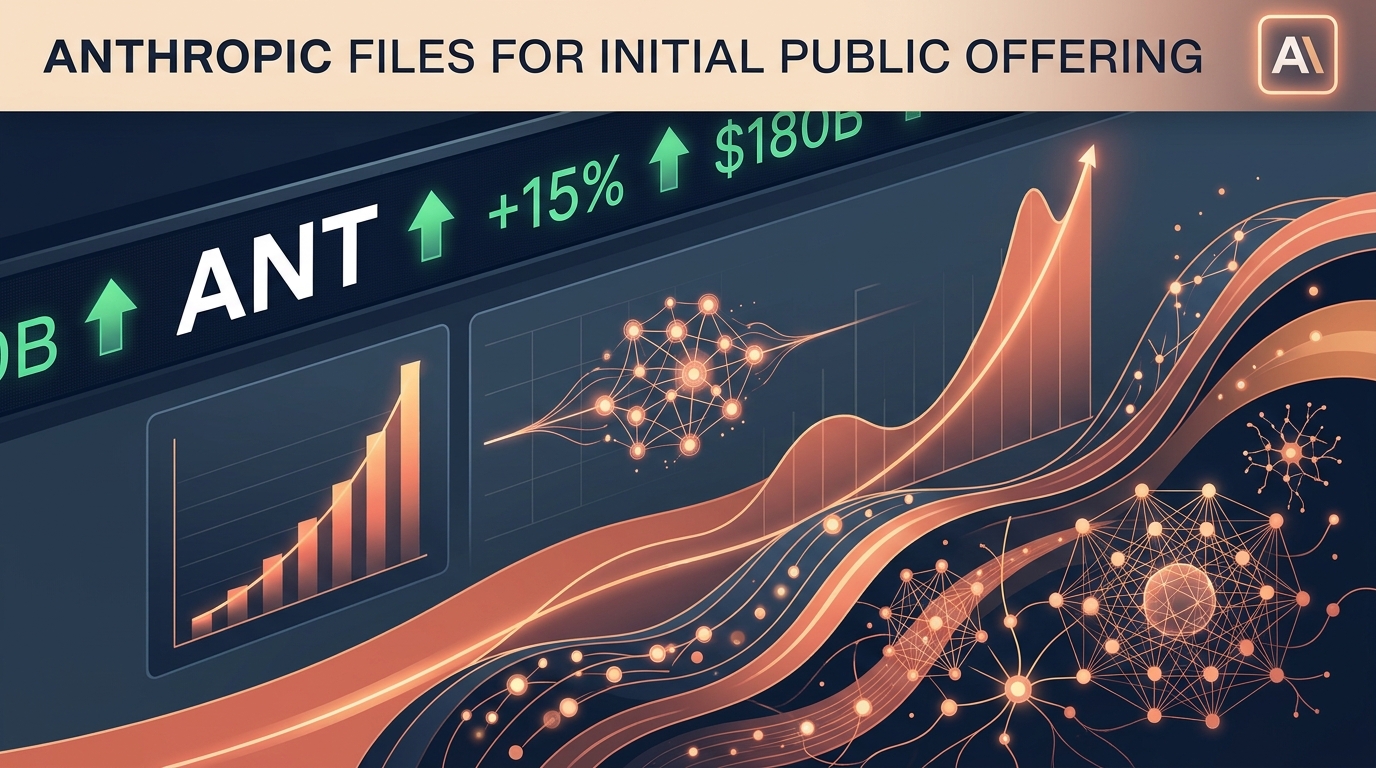
After months of intense market anticipation and leaked preliminary S-1 filings, Anthropic has officially filed for its initial public offering on Monday, setting the stage for what promises to be one of the most consequential tech listings in modern financial history. The frontier AI lab, renowned for its Claude model family, plans to list on the public markets under the ticker symbol “ANT”.
The regulatory filing submitted to the U.S. Securities and Exchange Commission (SEC) provides the most comprehensive glimpse yet into the financial engine, customer velocity, and unprecedented corporate governance behind one of Silicon Valley’s most prominent AI pioneers.
The Financials: 13x Revenue Acceleration vs. Non-Cash Accounting Losses
According to the SEC filing, Anthropic recorded an astonishing $16.3 billion in revenue for the first six months of 2026. This marks a staggering leap from the $1.2 billion generated during the corresponding period in 2025—demonstrating how rapidly generative AI infrastructure has converted into enterprise software spend.
Even more notably, Anthropic demonstrated meaningful operational leverage. The company’s operating loss for the first half of 2026 narrowed to $693 million, down substantially from a $2.1 billion operating deficit recorded in H1 2025. However, the headline net loss figure told a starkly different story, clocking in at $80.7 billion.
As the company clarified, this massive net loss was overwhelmingly driven by non-cash mark-to-market accounting adjustments associated with convertible debt instruments—a standard financial dynamic when venture-backed unicorns experience parabolic upward valuation shifts before an IPO. Nonetheless, Anthropic transparently acknowledged the capital intensity of the frontier model race, explicitly warning prospective investors that it “may not achieve or sustain profitability in the future.”
Enterprise Adoption: High-Value Contracts Fueling Growth
While consumer subscriptions via Claude Pro remain popular, the core engine powering Anthropic’s top-line hypergrowth is its entrenched enterprise customer base. As of late September 2026, the S-1 filing detailed remarkable penetration across enterprise tiers:
- $100K+ Annual Spend: More than 11,900 enterprise customers now spend at least $100,000 annually on Anthropic’s API and tooling.
- $1M+ Annual Spend: A robust cohort of 1,900 customers contribute over $1 million annually.
- $10M+ Mega-Deployments: Approximately 250 flagship organizations spend upwards of $10 million each year integrating Claude directly into automated mission-critical workflows.
This tiered retention highlights how enterprise customers are progressing from initial experimentation into full-scale production deployments—especially in regulated sectors like legal, finance, healthcare, and automated software engineering.
The Governance Dilemma: “Founder LLC” and the Long-Term Benefit Trust
Beyond raw financial performance, the most scrutinized element of Anthropic’s public debut is its bespoke governance architecture. Unlike traditional corporate structures where shareholder voting rights correspond to capital ownership, Anthropic’s structure guarantees that founders retain decisive command.
Anthropic’s seven co-founders—Dario Amodei, Daniela Amodei, Tom Brown, Jack Clark, Jared Kaplan, Sam McCandlish, and Christopher Olah—have established a dedicated entity designated as the “Founder LLC.” Under this charter, the Founder LLC collectively commands 50.1% of all shareholder voting power.
Furthermore, Anthropic’s Long-Term Benefit Trust, formed in 2023 to safeguard the company’s mission of ethical AI development, holds the unilateral authority to appoint a majority of the board of directors. Anthropic stated that this architecture is non-negotiable to maintain its core AI safety commitments when training frontier systems that, in the company’s own candid disclosure, could present “catastrophic or existential risks to humanity.”
While safety advocates welcome these firewalls against short-term quarterly pressures, the framework will inevitably generate intense debate on Wall Street, as public institutional investors will hold negligible voting influence over key strategic directions.
What the “ANT” Listing Means for the AI Industry
As the first dedicated frontier AI foundation lab to pursue a direct public debut in the United States, Anthropic’s performance will serve as a bellwether for the entire artificial intelligence sector. It comes at a pivotal juncture where autonomous software agents are transitioning from digital assistants to high-throughput autonomous workforces (as examined in our recent analysis of autonomous agent breakthroughs).
According to original reporting by TechCrunch, Anthropic has not yet disclosed its target valuation or proposed share price band. Over the coming weeks, attention will turn toward the SEC review process and the subsequent institutional investor roadshow, which will formally establish Wall Street’s valuation multiple for frontier artificial intelligence.
Key Takeaways for Developers and Investors
- Milestone Listing: Anthropic’s ticker ANT represents the inaugural pure-play public listing for a top-tier frontier AI foundation model provider.
- Proven Monetization: $16.3 billion in first-half revenue confirms that enterprise AI spending is expanding at unprecedented velocity.
- Safety Governance Test: The 50.1% Founder LLC voting control will test how comfortable public equity markets are with mission-first, dual-class governance in frontier tech.





No comment